
“How Do I Figure Out What My Goals Should Be?”
Imagine you are laying down a brick every time, where you work out in the gym. You can do this...
The truth? That depends—and it changes every time you train. Most people don’t realize how complex things really are. Or maybe they don’t want to see it. Sometimes, we don’t even need to know. When you practice something, you don’t always have to dive deep into theory. Using a few core principles is often enough.Still, I believe that having some understanding of the underlying concepts can change how you approach your daily practice. It can even improve consistency.This article isn’t based on a study or trial. Its goal is to cultivate understanding of core principles, drawn from recurring observational patterns.
Of course, there are different approaches to reaching the same goals. But if we talk about pushing hard, it’s good to understand exactly what this means, because it also depends on how big your goals are. Let’s say it straight away: pushing hard is more of a beginner's strategy. Maybe it’s even a cultural or emotional mindset that helps you start something and keep going. But the reality is that a real athlete can’t rely on such a beginner method to thrive long-term without it taking a toll on health. You need more advanced approaches to maintain top-level athleticism. This is where caring comes into the picture. If you learn to care for yourself a little more each day, you can keep growing and maintaining your top-level performance. Pushing vs. Caring is one of those core principles we’ve mentioned and will revisit throughout this series. In this article, I want to delve into the next obvious question: How hard do I “exactly” need to push?
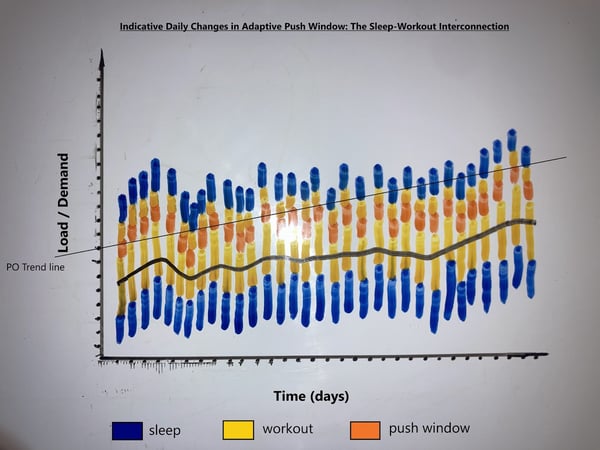
Graph A: Indicative Daily Changes in Adaptive Push Window: The Sleep-Workout Interconnection
Let’s look at how a daily changing adaptive push window looks like. This usually depends on a lot of factors. In this graph (A) we just viewed two interconnected factors; sleep & workout.
The sleep line is longer and contains the workout line in it because how hard you can work out effectively depends strongly on how well you sleep. It’s important to understand that if your sleep window shrinks or suffers in another way, this will affect your workout window. An affected workout window will affect your adaptive push window. It also can affect your adaptation in other complex ways.
The workout line itself is also important. If you widen your workout window and decide to train for hours you will notice your adaptive push window can shrink or grow too.
The adaptive push window is the window where your body can adapt biologically while pushing. This is not some kind of luxurious place to be. It’s important to understand that if you don’t push the right intensity, your body is not even going to adapt to your training.
Not pushing hard enough will prevent your muscles from activating the adaptation systems to grow.
Pushing harder will activate some biological panic reactions that prevent your body from adapting, because it has to survive. Hence if you look carefully you see there is a yellow spot above the pushing window. (Graph A) That means pushing 95%, for example, is already too much—your joints may start taking over the load. This is very important, especially if your main goal is hypertrophy (increasing your muscle mass)!
Start your coaching journey at Step by Step Training if you want to know how this looks or feels like in your own training, personally or keep following our blog for more articles about this topic.
The PO Trend line shows how the progressive overload trends over time. Progressive overload is a training method. This trend line basically shows that you don't even have to push harder every session to make progress and successfully apply progressive overload. Even worse, it can undermine your progression!
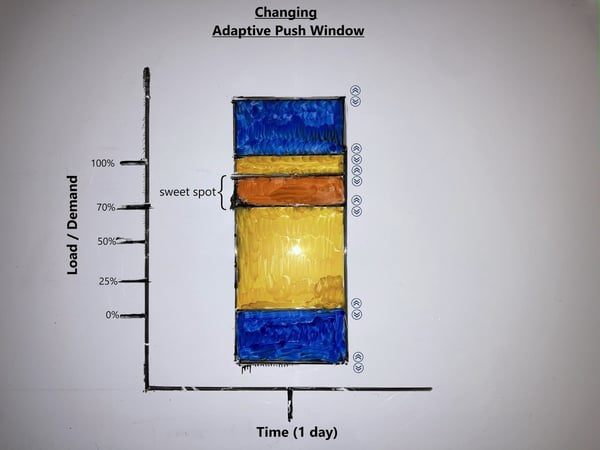
Graph B: Changing Adaptive Push Window
We have seen how a changing adaptive push window works over time. Let’s zoom in on one day or one training session to see what is happening on a daily basis. Remember that these graphs show just 2 factors; sleep & workout. In reality there are a lot more factors. Let’s analyze the patterns just in these 2 factors. The moving arrows show what is changing.
If we look closely we see that each factor has his own maximum threshold. This means you can grow in your workout but also in your sleep and other factors. This means that if you don’t grow in your sleep you can’t grow in your workout. This also means that if you have a bad night's sleep, you can’t expect your body to adapt like before. The factor of sleep in particular is really complex on its own. Because for example if you had a bad sleep you can’t always fix this even if you sleep again during the day time. This means you need a whole additional day to pass to get that valuable good night sleep again.
Your workout also has a maximum threshold. Maybe you sleep well but do you also train hard enough to use that fuel you tanked at night? Maybe you do and still struggle to find your sweet spot. Then there can also be other factors that are swallowing your energy without you noticing.
We also see that each factor has his own minimum threshold. It’s important to understand that things can go either way. For example if you don’t move enough in a day. Your sleep can also be compromised. Because your nervous system needs enough effort and tiredness to switch on to recover mode when you want to rest. You can even stay alert all the time and hear people say you have to rest, while the problem is in you not moving physically enough.
So, finding your sweet spot is one thing. Adjusting your programming on the change that occurs daily is another thing. Do you need to work on all these things together to achieve your goals? Eventually, but not right away luckily. These were you need this ancient principle; work always on your weakest link. Think about a chain. This chain contains a lot of links. If you want to make this chain strong. You can grow each link. But if there is one particular link you don’t work on like an injury or weak muscle in your body. The chain can never get stronger. If someone pulls that chain it will always break at that particular weakest link.
I often hear people say; “I am not an athlete. I can’t push myself as hard. I don’t have the same discipline." to show their appreciation to athletes. Or sometimes I hear people say; “I will train like an athlete.” and start pushing themselves harder that day out of inspiration.
The reality is that an athlete doesn’t push harder than you need to push yourself to achieve success! It’s the cumulative time they are able to keep pushing over years and this is only possible if you stop pushing and start caring more for yourself. Then you will understand and feel that you have to push yourself a little on your own level of performance, exactly how an athlete does on the level reached over time. The higher level becomes in this case like a base level over time. Now you understand the difference between peak performance and progression.
I can feel you getting overwhelmed. In this you have all the right to complain. But does it have to be this complex? No! At Step by Step Training we gave the buttons to you.
Sometimes you just want to focus and execute. You can leave the thinking and solving to your coach. At Step by Step Training we develop the right tools to simplify the complexity. We teach people the right practices. These practices are ancient techniques that have worked for thousands of years!
Sometimes you can’t go on doing your exercises. You feel the need to understand. Why do I have to do this in this particular way? Then it’s time to turn the button to understanding more through reading or listening to how things work. That’s when we do theory days. It’s always your call! But we always promote improving yourself in body wisdom and self-coaching.
Are you ready to find out your own weakest link? Do you want to learn how to train and progress in a way that your workout isn’t a burden? Do you want to have some tools to simplify the complexity and dismantle the plateaus you're reaching? Reach out to us at Step by Step Training! So, we can think with you without any obligation.
Do you have questions or thoughts about this topic? If you want to continue the discussion, leave a comment. And if you’d like personal guidance, feel free to reach out — no strings attached.
Imagine you are laying down a brick every time, where you work out in the gym. You can do this...