
How hard do I “exactly” need to push?
The truth? That depends—and it changes every time you train. Most people don’t realize how complex...
Imagine you are laying down a brick every time, where you work out in the gym. You can do this consistently for years — and yet it’s possible that you didn’t build a wall. Yes! You heard it right, consistently for years. How is that possible and why is this happening?
This brick laying analogy is about making progress. To build a wall, you need more than just laying bricks. You need direction. If bricks aren’t placed in a particular spot and in a coordinated way, you don’t get a wall — you get a heap of bricks. And no matter how many bricks you collect, a heap can’t hold a roof.
Training works the same way. Effort alone isn’t enough.
So how do you choose your goals? What should your goals be? Is it just personal preference? Can you simply choose the coolest ones?
I’m afraid not.
Okay, of course you can! Nobody can say what you have to do!
But eventually if you want to make some real progress you have to work on your weakest link. Yes, you heard that right. Again that word: weakest link.
Think of a chain made of many links. Some are shiny, some are thick, some are thin. You can work endlessly on one link, making it bigger and stronger, but sadly that doesn’t mean the chain as a whole becomes stronger.
A chain is only as strong as its weakest link.
Even if every other link improves, avoiding just one weak link — an injury, a limitation, a lack of mobility, poor recovery — means the chain will always break at that same point.
This is exactly how the body works. If you avoid working on your weakest link, progress will eventually stop.
This technically means you don’t really have the luxury of choosing your goals purely based on preference — at least if you really want to keep progressing!
Of course you can choose an end point. An ideal version of where you want to be.
But once the direction is set, your body decides what needs attention first. Even if you want to grow even more in your natural talent, you will still be forced to work on what you currently lack.
So, why not start with your weakest link right away?
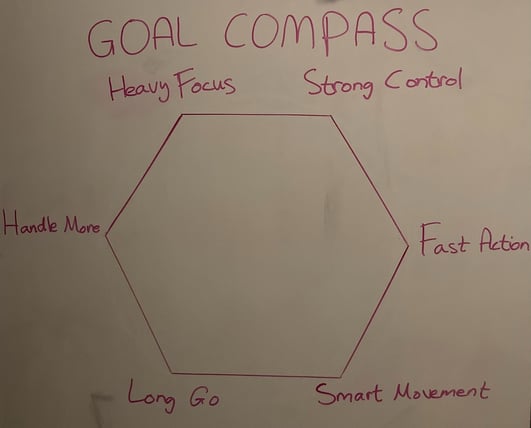
Graph A: Goal Compass
Here you see a set of basic training goals arranged like a compass (Graph A). Just like a real compass, opposite directions are placed far apart because they demand very different types of effort from the body.
The Goal Compass doesn’t show exercises or programs. It shows the fundamental ways the body can adapt to training. By understanding these directions, you can work toward almost any goal — athletic or not. Fat loss, recovery, moving better, feeling stronger, performing better, or even goals outside of sports.
You might also have multiple goals at the same time. The key question isn’t what your goal is, but what kind of stress that goal requires from your body.
By placing your goal as a point within the compass, you can translate it into the right kind of training. The compass also reveals which goals support each other, which interfere, and which should be separated in time. When placed correctly, it often shows why certain approaches don’t work for you — and where your body is lagging.
I’m afraid that is not true my friend.
Even if it were true, you would need multiple lifetimes to reach your goals that way.
“But it works sometimes?”
With small goals, when you are just a beginner, almost everything works — for a while.
As a matter of fact this approach of just pushing hard enough and long enough, without direction, can actually move you even farther away from your goals!
This is why direction matters more than effort.
Are you ready to build resilience in your hardest workouts? Are you ready to map out where you want to grow — and why? Are you ready to stop guessing and start progressing in a way that improves your quality of life?
Reach out to us at Step by Step Training, and we’ll think along with you — completely without obligation.
Do you have questions or thoughts about this topic? If you want to continue the discussion, leave a comment. And if you’d like personal guidance, feel free to reach out — no strings attached.
The truth? That depends—and it changes every time you train. Most people don’t realize how complex...